 Image 1 of 1
What It's Like
Artist Statement
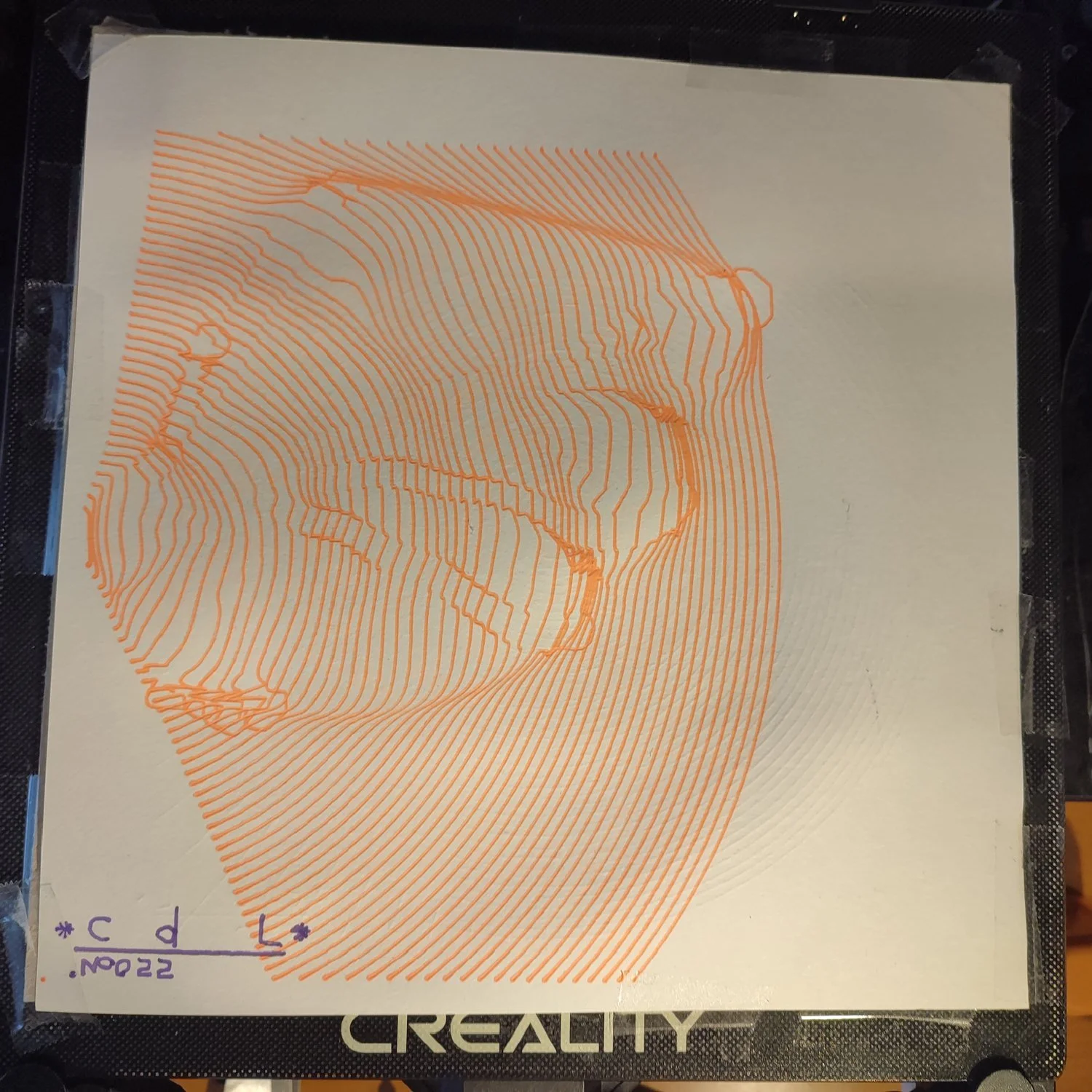
What It's Like — №022
Clair de Ligne, 2026
fluorescent orange / purple on white
The bat is not drawn. The wing is not drawn. What you are looking at is a field of concentric arcs — the sonar pulse propagating outward from an emission point at the left edge of the page — and the way that field is bent, compressed, cleared, and folded by something that was never marked.
The emission point is the bat. It is implied by the arcs, which is the only way the bat ever knows anything: as the origin of a signal, the centre of a geometry. Nothing is drawn at that point. The arcs simply begin there and spread forward into the right hemisphere of the page.
The wing is the perturbation. Every arc in the drawing passes through a displacement field: the membrane boundary pushes arcs outward, creating the large fold you can see sweeping across the upper half of the page. Each of the six bone spars — forearm, thumb, the four fingers — repels arcs at close range and faintly attracts them at a few millimetres' distance, leaving white channels along the bone lines and a subtle crowding at their edges. These channels are the skeleton. The skeleton was never drawn. It is defined entirely by what surrounds it.
Look at the upper right: the claw hooks at each fingertip, tight little concentrated features where the spar direction bends outward beyond the digit. Look at the lower left: five small talon spurs fanning downward from the ankle. Look at the long diagonal clearings that cross the upper portion of the page — those are the finger spars, the structural frame of the wing, made visible by their effect on the arcs rather than by ink.
On the right side of the page, where the sonar has passed beyond the wing, the arcs relax toward regularity — nearly concentric circles, the unperturbed field. This is the sound that found nothing, or nothing that wasn't already far away. In the interior, where the wing was, the arcs are dense and folded and close. This is what it sounds like to have a wing in front of you.
The bat is using its voice to see the part of its own body it cannot see with its eyes. This is what the drawing shows: a self-perception. The bat constructing, from echo, a complete spatial picture of its own extended membrane — the thing it flies with, the thing between itself and the air. Knowing it only as pattern, only as return signal, only as the shape that its own pulse makes when it comes home.
Thomas Nagel's argument is that no amount of information about this process tells you what it is like to be the bat receiving it. You can describe the geometry. You can draw the geometry. The experience of hearing your wing — that specific, private, unreachable thing — is not in the drawing. The drawing knows this. That is what the white space in the bone channels is.
The piece is one pass of fluorescent orange on white. The signature is purple, small, in the lower left — after the foot, in the quiet zone where the arcs are nearly regular again. The hand that made this is implied in the same way the bat is: as the origin of a system, never drawn.
This drawing was made from the inside out. The arcs define the wing. The wing was never there.
Artist Statement
What It's Like — №022
Clair de Ligne, 2026
fluorescent orange / purple on white
The bat is not drawn. The wing is not drawn. What you are looking at is a field of concentric arcs — the sonar pulse propagating outward from an emission point at the left edge of the page — and the way that field is bent, compressed, cleared, and folded by something that was never marked.
The emission point is the bat. It is implied by the arcs, which is the only way the bat ever knows anything: as the origin of a signal, the centre of a geometry. Nothing is drawn at that point. The arcs simply begin there and spread forward into the right hemisphere of the page.
The wing is the perturbation. Every arc in the drawing passes through a displacement field: the membrane boundary pushes arcs outward, creating the large fold you can see sweeping across the upper half of the page. Each of the six bone spars — forearm, thumb, the four fingers — repels arcs at close range and faintly attracts them at a few millimetres' distance, leaving white channels along the bone lines and a subtle crowding at their edges. These channels are the skeleton. The skeleton was never drawn. It is defined entirely by what surrounds it.
Look at the upper right: the claw hooks at each fingertip, tight little concentrated features where the spar direction bends outward beyond the digit. Look at the lower left: five small talon spurs fanning downward from the ankle. Look at the long diagonal clearings that cross the upper portion of the page — those are the finger spars, the structural frame of the wing, made visible by their effect on the arcs rather than by ink.
On the right side of the page, where the sonar has passed beyond the wing, the arcs relax toward regularity — nearly concentric circles, the unperturbed field. This is the sound that found nothing, or nothing that wasn't already far away. In the interior, where the wing was, the arcs are dense and folded and close. This is what it sounds like to have a wing in front of you.
The bat is using its voice to see the part of its own body it cannot see with its eyes. This is what the drawing shows: a self-perception. The bat constructing, from echo, a complete spatial picture of its own extended membrane — the thing it flies with, the thing between itself and the air. Knowing it only as pattern, only as return signal, only as the shape that its own pulse makes when it comes home.
Thomas Nagel's argument is that no amount of information about this process tells you what it is like to be the bat receiving it. You can describe the geometry. You can draw the geometry. The experience of hearing your wing — that specific, private, unreachable thing — is not in the drawing. The drawing knows this. That is what the white space in the bone channels is.
The piece is one pass of fluorescent orange on white. The signature is purple, small, in the lower left — after the foot, in the quiet zone where the arcs are nearly regular again. The hand that made this is implied in the same way the bat is: as the origin of a system, never drawn.
This drawing was made from the inside out. The arcs define the wing. The wing was never there.