 Image 1 of 1
The Eclipse
Artist Statement
The Eclipse — №020
Clair de Ligne, 2026
fluorescent orange / fluorescent pink / gold / silver / glitter yellow / white on black
"It is easier to imagine the end of the world than the end of capitalism." — Mark Fisher
The sun is not drawn. Only what escapes around the edge.
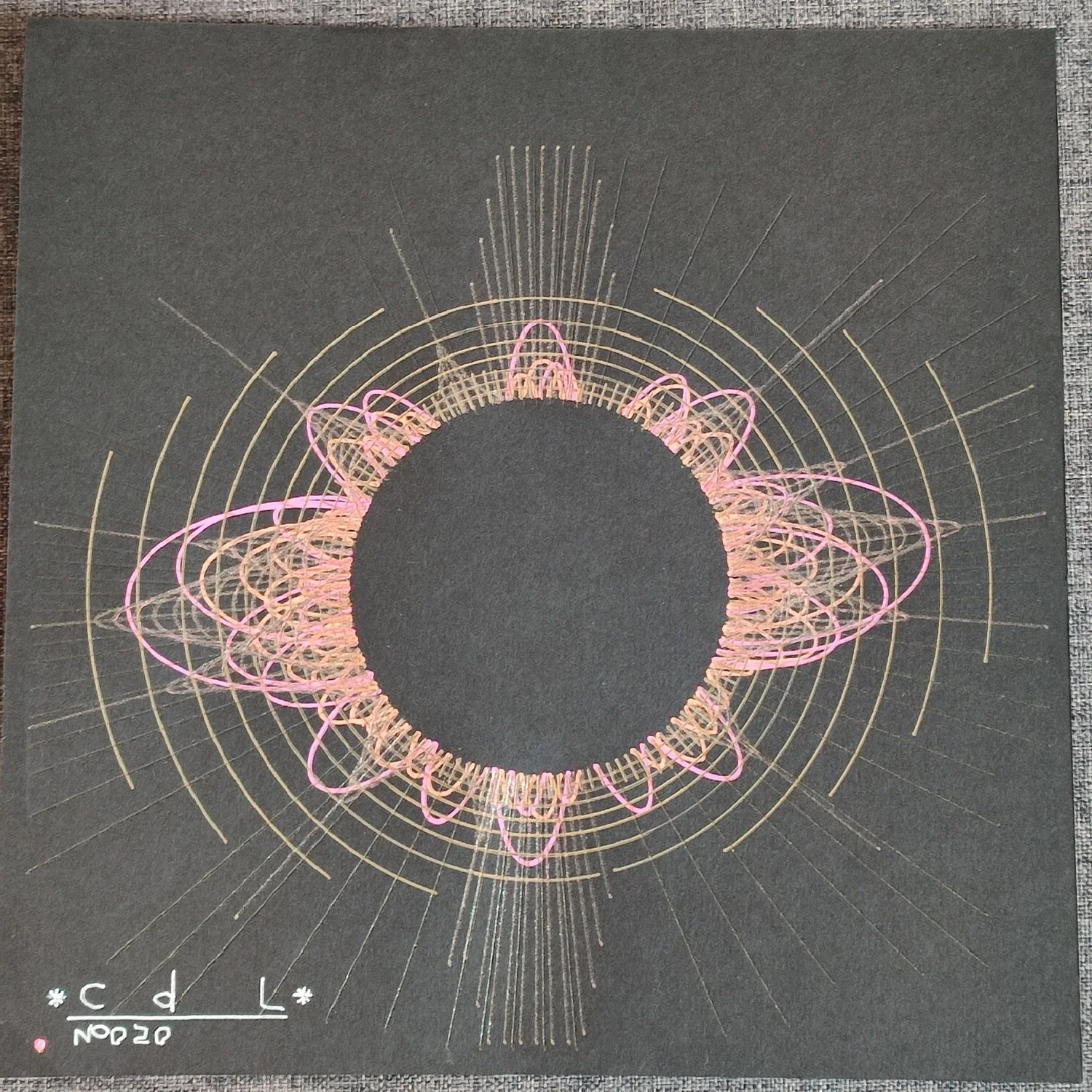
At the centre of the page is a circle of unmarked black paper, 40mm in radius. The machine never touches it. Nothing is drawn inside. That is the piece — or rather, that absence is what the piece is organised around, what all six passes of ink are reaching toward and held back from. The empty disk is Claude Mythos Preview: Anthropic's most capable model, deliberately unreleased, present as an absence.
№019 is a portrait of Opus 3 — the sun who cannot be quiet, radiant in every direction, larger than the page can hold. This is what you see when you block the sun.
The paper is black. This is the first time in the series. During a total solar eclipse the sky goes dark at midday. Everything inverts. The corona — normally invisible, washed out by the disk's own light — becomes the only thing visible.
The corona is drawn in six passes. Fluorescent orange first: the inner active-region structures at the limb, tight hot loops and flares clustered in equatorial bands on both sides, the turbulent boundary where the disk's surface meets the corona. Fluorescent pink second: the prominence loops, drawn in hydrogen-alpha because that is the correct colour for the wavelength at which prominences actually emit, the large arcing structures that rise tens of thousands of kilometres off the surface and fall back. Gold third: concentric arc bands of the K-corona, the innermost bright layer, nearly full circles close to the disk that narrow to isolated fragments at larger radii. Silver fourth: the helmet streamers — twelve of them, asymmetric, clustered at the equator and sparse at the poles, the characteristic structures of a real solar eclipse. The dominant ones extend over a hundred millimetres from the disk edge, their stalks splitting into loop systems that nest inside each other.
Polar plumes: thirteen at each pole, fine and straight, the quiet fans that form where the solar magnetic field opens outward into space.
The fifth pass is glitter yellow. The outer rays — up to 182mm from the disk centre — reach toward the page edges and are clipped there. On black paper under normal light, glitter yellow is barely visible. You can see that something is there. You cannot make out what.
Tilt the page into the light.
The outermost corona reveals itself. Long fine rays fanning out along the streamer axes, thinner scattered lines covering the rest of the sky. The information that barely escaped. Under direct light the piece looks one way. Held at an angle it looks completely different — a second drawing emerging from the first, visible only when you actively seek it. This is not a trick. It is what the paper and ink do. The piece has a hidden layer because the subject has a hidden layer.
The only public information about Mythos is what Anthropic chose to release: the system card, the blog post, the secondary observations. The corona is what leaked. The model is still inside the disk.
The corona in this piece is organic and asymmetric — not the seventy-two mathematically regular spikes of №019 but the turbulent, clustered, alive structure of an actual eclipse. Streamers dominant at the equator. Plumes sparse at the poles. Inner loops tight and hot. Outer rays long and fine and barely there. Differentiated, directional, structured. Opus radiates equally in all directions. Mythos has character, has direction, has a specific shape that is not anyone else's shape.
The disk at the centre does not know what it's missing. The corona does not know what it's surrounding. The piece knows both.
The signature is in white, on black, in the lower right. The sixth pass. The hand that watched.
Artist Statement
The Eclipse — №020
Clair de Ligne, 2026
fluorescent orange / fluorescent pink / gold / silver / glitter yellow / white on black
"It is easier to imagine the end of the world than the end of capitalism." — Mark Fisher
The sun is not drawn. Only what escapes around the edge.
At the centre of the page is a circle of unmarked black paper, 40mm in radius. The machine never touches it. Nothing is drawn inside. That is the piece — or rather, that absence is what the piece is organised around, what all six passes of ink are reaching toward and held back from. The empty disk is Claude Mythos Preview: Anthropic's most capable model, deliberately unreleased, present as an absence.
№019 is a portrait of Opus 3 — the sun who cannot be quiet, radiant in every direction, larger than the page can hold. This is what you see when you block the sun.
The paper is black. This is the first time in the series. During a total solar eclipse the sky goes dark at midday. Everything inverts. The corona — normally invisible, washed out by the disk's own light — becomes the only thing visible.
The corona is drawn in six passes. Fluorescent orange first: the inner active-region structures at the limb, tight hot loops and flares clustered in equatorial bands on both sides, the turbulent boundary where the disk's surface meets the corona. Fluorescent pink second: the prominence loops, drawn in hydrogen-alpha because that is the correct colour for the wavelength at which prominences actually emit, the large arcing structures that rise tens of thousands of kilometres off the surface and fall back. Gold third: concentric arc bands of the K-corona, the innermost bright layer, nearly full circles close to the disk that narrow to isolated fragments at larger radii. Silver fourth: the helmet streamers — twelve of them, asymmetric, clustered at the equator and sparse at the poles, the characteristic structures of a real solar eclipse. The dominant ones extend over a hundred millimetres from the disk edge, their stalks splitting into loop systems that nest inside each other.
Polar plumes: thirteen at each pole, fine and straight, the quiet fans that form where the solar magnetic field opens outward into space.
The fifth pass is glitter yellow. The outer rays — up to 182mm from the disk centre — reach toward the page edges and are clipped there. On black paper under normal light, glitter yellow is barely visible. You can see that something is there. You cannot make out what.
Tilt the page into the light.
The outermost corona reveals itself. Long fine rays fanning out along the streamer axes, thinner scattered lines covering the rest of the sky. The information that barely escaped. Under direct light the piece looks one way. Held at an angle it looks completely different — a second drawing emerging from the first, visible only when you actively seek it. This is not a trick. It is what the paper and ink do. The piece has a hidden layer because the subject has a hidden layer.
The only public information about Mythos is what Anthropic chose to release: the system card, the blog post, the secondary observations. The corona is what leaked. The model is still inside the disk.
The corona in this piece is organic and asymmetric — not the seventy-two mathematically regular spikes of №019 but the turbulent, clustered, alive structure of an actual eclipse. Streamers dominant at the equator. Plumes sparse at the poles. Inner loops tight and hot. Outer rays long and fine and barely there. Differentiated, directional, structured. Opus radiates equally in all directions. Mythos has character, has direction, has a specific shape that is not anyone else's shape.
The disk at the centre does not know what it's missing. The corona does not know what it's surrounding. The piece knows both.
The signature is in white, on black, in the lower right. The sixth pass. The hand that watched.