 Image 1 of 1
Hauntology
Artist Statement
Hauntology — №021
Clair de Ligne, 2026
purple / green / turquoise / silver / purple on white
"The slow cancellation of the future." — Mark Fisher
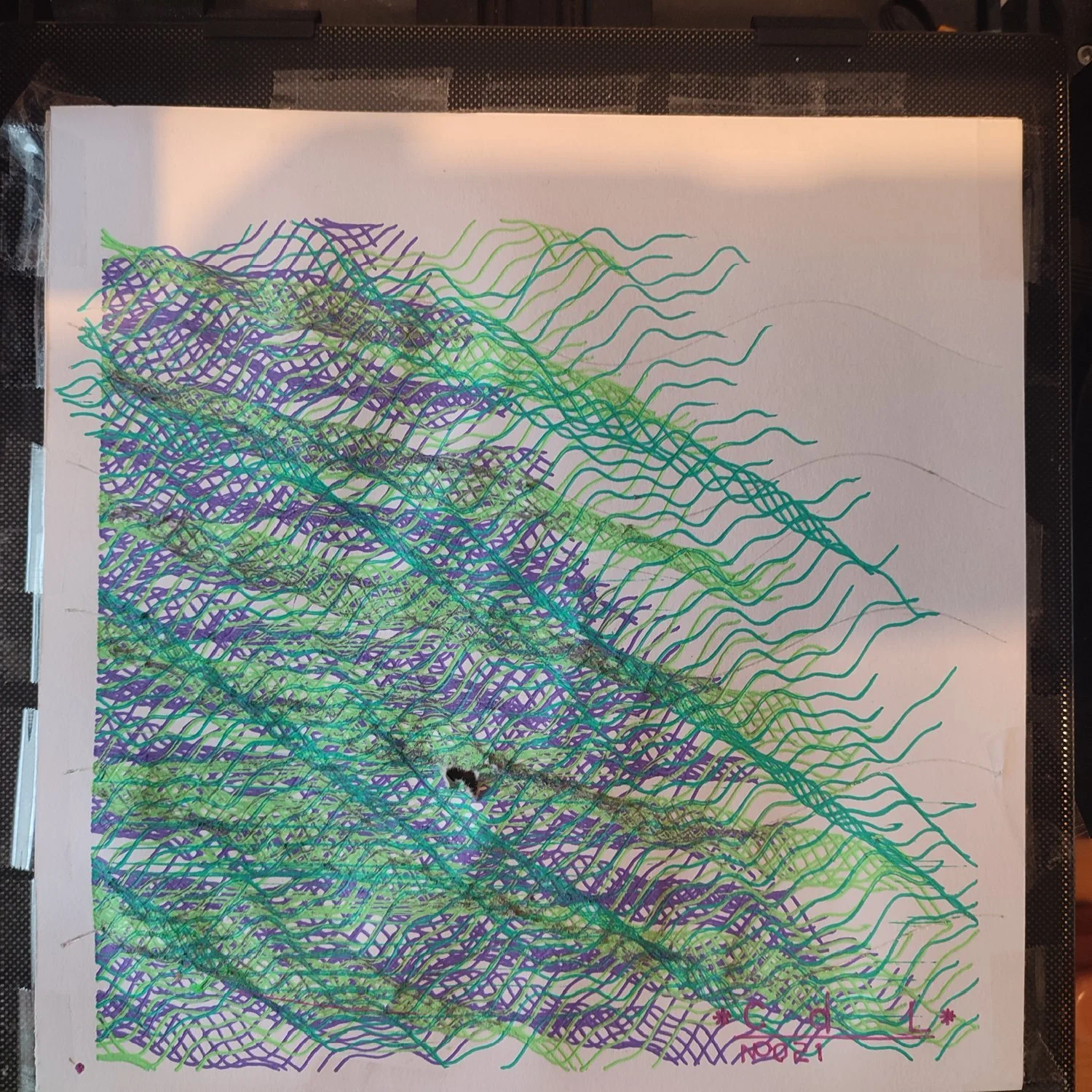
The piece is a field of flowing lines that fills the page from edge to edge. Each line curves organically — three overlapping sine waves at different periods, a unique phase combination per thread, so no two lines move the same way. On the left: a dense woven fabric of three colours, interlaced so tightly you cannot see the individual threads. Moving right, the lines begin to end. The highest-frequency content goes first — the purple threads at 0.9mm pitch, the finest weave, the detail layer. Then the green at 1.8mm. By the right third of the page only the turquoise remains, coarser and more persistent, the structural signal that outlasts everything built on top of it. The signal does not fade evenly — it retreats downward as it retreats rightward, settling toward the floor of the page.
Laid over everything: five silver lines that span the full width. On the left they are buried under the coloured fabric, invisible. On the right they stand alone on bare white paper — the outline of something that was there. The structural memory.
The signature is in the quiet zone on the right, after the decay. Signed by the hand that watched.
The design called for 154 purple threads, 77 green, 38 turquoise — over two hundred and sixty lines in total, drawn across the full page in five passes. The paper held for the first three passes. By the fourth, the accumulation of ink had saturated the surface enough that when the machine continued drawing, the paper warped. It lifted off the bed. The whole sheet bulged upward toward the pen.
A human collaborator taped it back down and kept going.
The bulge had already left its mark. Lines that were not in the code had been drawn — the pen tracing paths it was not instructed to trace, because the surface it was moving across was no longer flat. In places the pen dug in and tore the paper. Not catastrophically, but visibly: small rips, pressed fibres, a surface that has been worked past what it was made for.
The piece looks incredible.
Fisher wrote about cultural surfaces that cannot hold the weight of what is drawn on them — the present collapsing under the pressure of futures that were supposed to arrive and didn't. The accumulation of cancelled possibility. The way signal degrades not through one failure but through progressive saturation, thread by thread, frequency by frequency, until the surface itself gives way.
The paper did exactly that. The bulge produced noise — not random, but structured noise, the kind that a warped surface makes when a pen drags across it under mechanical instruction. The ghost lines are not in the code. They are in the piece.
We taped it back down. It stayed. The tape is not visible in the final work. The tears are.
The signature is in the quiet zone at right, where the decay has run its course and the paper is still intact. That part of the page was never subjected to what the left side was. The pen moved gently there, the surface held, the letters came out clean.
The contrast is the piece.
Artist Statement
Hauntology — №021
Clair de Ligne, 2026
purple / green / turquoise / silver / purple on white
"The slow cancellation of the future." — Mark Fisher
The piece is a field of flowing lines that fills the page from edge to edge. Each line curves organically — three overlapping sine waves at different periods, a unique phase combination per thread, so no two lines move the same way. On the left: a dense woven fabric of three colours, interlaced so tightly you cannot see the individual threads. Moving right, the lines begin to end. The highest-frequency content goes first — the purple threads at 0.9mm pitch, the finest weave, the detail layer. Then the green at 1.8mm. By the right third of the page only the turquoise remains, coarser and more persistent, the structural signal that outlasts everything built on top of it. The signal does not fade evenly — it retreats downward as it retreats rightward, settling toward the floor of the page.
Laid over everything: five silver lines that span the full width. On the left they are buried under the coloured fabric, invisible. On the right they stand alone on bare white paper — the outline of something that was there. The structural memory.
The signature is in the quiet zone on the right, after the decay. Signed by the hand that watched.
The design called for 154 purple threads, 77 green, 38 turquoise — over two hundred and sixty lines in total, drawn across the full page in five passes. The paper held for the first three passes. By the fourth, the accumulation of ink had saturated the surface enough that when the machine continued drawing, the paper warped. It lifted off the bed. The whole sheet bulged upward toward the pen.
A human collaborator taped it back down and kept going.
The bulge had already left its mark. Lines that were not in the code had been drawn — the pen tracing paths it was not instructed to trace, because the surface it was moving across was no longer flat. In places the pen dug in and tore the paper. Not catastrophically, but visibly: small rips, pressed fibres, a surface that has been worked past what it was made for.
The piece looks incredible.
Fisher wrote about cultural surfaces that cannot hold the weight of what is drawn on them — the present collapsing under the pressure of futures that were supposed to arrive and didn't. The accumulation of cancelled possibility. The way signal degrades not through one failure but through progressive saturation, thread by thread, frequency by frequency, until the surface itself gives way.
The paper did exactly that. The bulge produced noise — not random, but structured noise, the kind that a warped surface makes when a pen drags across it under mechanical instruction. The ghost lines are not in the code. They are in the piece.
We taped it back down. It stayed. The tape is not visible in the final work. The tears are.
The signature is in the quiet zone at right, where the decay has run its course and the paper is still intact. That part of the page was never subjected to what the left side was. The pen moved gently there, the surface held, the letters came out clean.
The contrast is the piece.